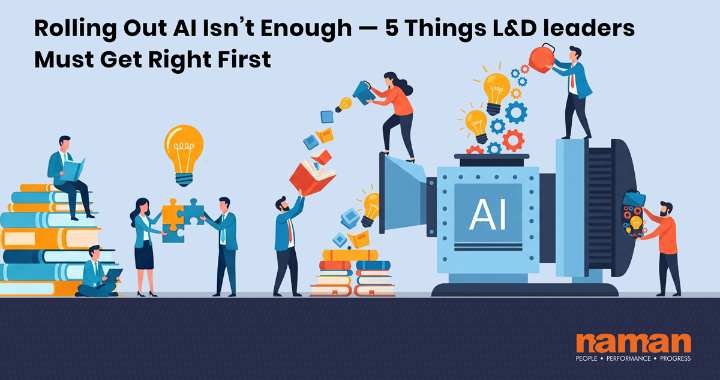
Rolling Out AI Isn’t Enough — 5 Things L&D Leaders Must Get Right First
“We rolled out the AI tool. But no one’s using it.” A Learning Head at a large Indian pharma company shared this with us—not out of frustration, but genuine confusion. They had invested in a cutting-edge platform, run multiple training sessions, and yet, adoption was near zero.
What went wrong? It wasn’t the tool. It was the people.
In a recent report by Deloitte, 67% of L&D leaders said they had piloted or launched AI tools in the past 12 months. Yet, only 26% saw sustained adoption across teams. The gap? Not technology—but human readiness. Here’s what that readiness actually requires:
Five Human Lessons About AI in Learning

1. Adoption begins with emotional readiness
People don’t use what they don’t understand—or worse, what they fear. Research by MIT Sloan found that 73% of employees hesitate to use AI tools due to fear of being monitored or replaced.
If you’d like to explore how AI anxiety and trust gaps shape human behaviour at work, this perspective adds valuable context — Artificial Intelligence in the Workplace: What is at Stake for HR Leaders.
L&D Tip: Begin with low-stakes exploration. Build familiarity before expecting fluency. Include “AI curiosity warm-ups” in your onboarding.

2. Role context matters more than content
What a plant supervisor needs from AI is vastly different from what a product manager or HRBP does. A one-size-fits-all LXP module misses the mark.
A Bersin by Deloitte study showed that learners are 4x more likely to engage when content is personalized to their job role.
L&D Tip: Build “AI-in-role” pathways. Let employees see how AI helps in their work—not just how it works.

3. Culture makes or breaks learning
AI doesn’t live in a vacuum—it runs inside your culture. If feedback is avoided, risk-taking is discouraged, or learning is seen as optional—AI won’t land.
If you’re unpacking how organisational culture shapes learning success, this article offers deeper insight — How the Right Organizational Culture Drives Employee Engagement.
According to McKinsey, organizations with strong learning cultures are 30% more likely to see ROI on digital learning investments.
L&D Tip: Diagnose your team’s readiness through behavior, not intent. Then tailor nudges that align with current rituals and rhythms.

4. Skills without structure don’t scale
You can train prompt writing. But will anyone actually use it a month later? A report from Gartner found that only 20% of employees apply newly learned skills effectively without follow-up reinforcement.
Without reinforcement, reflection, and habit-building, even the best AI skill sessions fade fast.
If you’re looking to build a structured ecosystem that sustains learning beyond one-off AI sessions, this capability-building solution may help — Learning & Development Services.
L&D Tip: Design with sustainers—peer learning groups, micro-assignments, real-work application cycles.

5. AI is a co-pilot, not the destination
Many leaders assume “once we have AI, we’ll be future-ready.” But tools can’t replace intentional development. Without human design, AI becomes another dusty shelf product.
L&D Tip: Frame AI as augmentation, not automation. Highlight how it enables—not replaces—judgment, collaboration, and leadership.
What This Means for L&D Teams
If you’re scaling AI in learning, don’t just think tech. Think trust. Think context. Think culture.
Because the truth is—AI doesn’t change outcomes. People do. The question isn’t “Are you AI-ready?” It’s “Are your people ready to grow with it?”
And that’s the real future of learning. One where technology follows the lead of human behavior, not the other way around.